Wednesday, April 30, 2008
Final Dog Park Project
“Dogs are our link to paradise. They don't know evil or jealousy or discontent. To sit with a dog on a hillside on a glorious afternoon is to be back in Eden, where doing nothing was not boring - it was peace.”
-Milan Kundera
I first fell in love with dogs as a small child- I would watch them from my stroller- desperately trying to squirm out my way to my furry friends. I have always been entranced by a dog’s passion for everything in life. They are equally excited to go for a car ride, go to the park, or simply receive a belly rub. When I moved to New York for college, my first extended time away from my family and my dog, I instantly found comfort in the Washington Square Dog Run. I would spend entire afternoons sitting in the Dog Run, and despite the occasional smell of dog pee when the wind turned my way, most of my favorite New York memories have occurred in that park. I soon discovered that there is so much more to the Washington Square Dog Run then cute puppies frolicking about off leash. In this dog run I found old friends catching up, romances just starting, high-powered business men and women networking and gushing about their “baby” Fido at the same time. The Dog Run provides a community and sense of stability in one of New York’s most historical and amorphous parks.
When I began this documentary study I had just finished Henry James’ Washington Square. I was in love with the era the book took place in; Washington Square Park was filled with grand balls, tea parties, and fairy tale like romances. Washington Square Park however is forever changing and soon transformed into a haven for artists and reactionaries alike. During the 20th Century it saw the likes of Edward Stieglitz, Jackson Pollack, Jack Kerouac, and Bob Dylan just to name a few. Real estate was cheap around the square in the mid century; many buildings were converted tenements and sweatshops, so it created a draw for many struggling and poor artists. Simon and Garfunkel, who lived on the south-west end of the park even wrote a song about Bleeker street, (which runs just south of the park) in which they mention how inexpensive the village was in the 60’s. In the song they say, “Thirty dollars pays your rent / on Bleeker Street.”
That was the Washington Square of the 60’s- my parents generation- I wanted to learn about the Washington Square of my generation. The one where a bottle of water costs two dollars from a vendor, rent starts around two thousand a month, and thirty dollars could hardly buy you dinner. My goal in documenting the dog park was to see how Washington Square Park has changed and explore what it has become by looking at a small community of people within it. What I found: thirty dollars may have once paid your rent, but today it won’t even pay for a dog walker!
On a nice day about 1000 dogs pass through Washington Square Park, of those more than half are being walked by professionals who are being paid, on average, 20-30 dollars an hour depending on the size of the dog. These professional dog walkers pick the dogs up from their home’s, walk them to the park and let them run around for a little less than an hour then walk them home. The dog walkers can also be paid extra to play with the dogs and groom the dogs. These services may cost a pet owner upwards of three hundred dollars a week. This may seem very expensive, but in an area where a million dollar apartment is considered cheap it is considered the norm. These prices reflect the prosperity that has flooded the area around Washington Square Park. For this documentary I talked with hundreds of people, and I heard many times a word that the dog owners seem to have invented to describe what has happened to their park: “yuppification.” The park has become gentrified, and while some were pleased, others were outraged. There was a mass consensus that the “yuppies” had moved in and were trying to take over Washington Square Park.
As history has seen time and time again, history is written by the victor, so the community has yet to decide if this “yuppification” has had a positive or negative effect on the park. Many of the dog owners love and deeply appreciate that the park has been cleaned up, there are less drug users and dealers wandering around, and less homeless men sleeping on the benches. However, with this change many artists and bohemians have also disappeared being replaced by NYU students and business people who can afford the rising costs of the village real estate market. Washington Square Park is currently undergoing a mass renovation, which will also increase gentrification. It has been met with many cheers from some and an uproar of resistance from others. At this time we are at a major fulcrum for change- when the park reopens it may have lost its artistic soul forever- or it may retain its bohemian aura and history- only time will tell.
I do believe that Washington Square Park has been changing for the better, but this documentary is not an advocacy piece for continued gentrification. This documentary is simply a time capsule of a very unique community in a very unique park, during a very unique time. I intend for each person to draw his or her own conclusion on the current state of the park and hope it can provide a window into this exciting and changing time for future generations.

TO THE TUNE OF IGNU IN THE KEY OF C.
hey guys-
here's the link to my magazine's "fan page," or whatever facebook calls it nowadays:
http://www.facebook.com/pages/TO-THE-TUNE-OF-IGNU-IN-THE-KEY-OF-C/11617709797
hopefully I will eventually graduate in two weeks and finish my all of my finals so I can make a more legit blog space for it.
it's kind of against my ethos to do this internet/electronic magazine blogging business, but I think it's probably the easiest way for the magazine to get further than I can reach with my own two arms and pair of hands. for now though, the first one is posted on the facebook page and you can see it in the photo albums section, although it's a little hard to read. anyway, enjoy those long lines of words within those stacks of stapled paper.
--nicole w.
here's the link to my magazine's "fan page," or whatever facebook calls it nowadays:
http://www.facebook.com/pages/TO-THE-TUNE-OF-IGNU-IN-THE-KEY-OF-C/11617709797
hopefully I will eventually graduate in two weeks and finish my all of my finals so I can make a more legit blog space for it.
it's kind of against my ethos to do this internet/electronic magazine blogging business, but I think it's probably the easiest way for the magazine to get further than I can reach with my own two arms and pair of hands. for now though, the first one is posted on the facebook page and you can see it in the photo albums section, although it's a little hard to read. anyway, enjoy those long lines of words within those stacks of stapled paper.
--nicole w.
Rebecca Furgeson
As many afternoons as I’ve spent in the park, I’ve never seen anyone cleaning it up or working there. Rebecca Furgeson talked about all these aspects of the park that I had no idea existed. Her job is to be in the park every day and I’m sure if anyone knows what’s going on there, it’s her. I’ve heard bits and pieces of what the renovation includes but I trust her facts more than the hearsay. Based on what she said in class, I’m a little more at ease about the changes being made to the park. The pavement has been terrible there for as long as I can remember (and I grew up on 8th st). The west side of the park is only sketchy because not as many people pass through there since it’s just a side street. I have no complains about the lowered fountain area- in fact, I LIKE it. It’s perfect for skating and it allows performers to use the concrete border/seating around the fountain area as a stage. The trees aren’t as healthy as they could be and there are dirt patches in the grass- that can easily be fixed without shutting down the park. I don’t see why the fountain needs to be moved to the center and improved! It’s not like the water was ever on in there anyway… I think a lot of the changes that needed to be made (lighting, pavement, trees, grass, more seating) could have been made without closing down the park for the next few years. Moving designated areas of the park around isn’t NECESSARY.
Tuesday, April 29, 2008
Hopper class
The professor (sorry, I’m a black hole for names) who came in to talk about Hopper brought up an interesting point. Because Hopper captures a single moment right around the climax of the story, countless different things could be happening in his paintings. I really enjoyed watching them act out different scenes from the diner painting. (Oh, and I had NO idea Hopper’s images were based on locations in NYC!) The feelings they pulled out from the painting ranged from serious to comical- completely opposite and neither was wrong! Ironically, the same diner painting showed up in another one of my classes that week. One guy in my self portrait photography class is taking well known paintings and working himself into the scene. For the Hopper painting, he was standing outside of the window and mooning the guy behind the counter. Anything, no matter how odd, CAN be happening in Hopper’s paintings!!!!
the window assignment
The picture: Through a first floor window on 9th st, between 5th & 6th ave, I see an adult holding a toddler and the family’s pet cat is sitting on the windowsill. The child is held in midair, about a foot from the woman’s body. They are looking at each other, but his arm is outstretched, reaching or pointing towards the window. They’re standing relatively close to the window and I can’t see the floor or back of the room.
Scene 1
Mother: Your diaper is clean… Are you hungry? Do you want some Cheeeeeerios?
Husband, from across the room: What’s wrong with him?
Mother: I don’t know. He’s being fussy but his diaper is just fine and it’s not his usual naptime.
Husband: Maybe he wants to go outside; look he’s pointing to the window!
Mother: Tommmmmy? Do you want to go play on the swings?
Boy: Swingsss!
Mother: Yes! Maybe your friends are there too… (Turns to husband.) Honey, do you want to come to the park with us?
Husband: Uhhh…Okay, but I gotta go back to work soon.
Scene 2
Nanny: We have to clean up the room, Mickey. Mommy’s coming home soon.
Boy: She’s outside!
Nanny: Yes she is! Want to look out the window? See if she’s almost here?
(They get closer to the window. Cat meows.)
Boy: Kitty!
Nanny: Well, it doesn’t look like mommy’s on this block yet. We still have to clean up after playtime and feed the cat.
Scene 1
Mother: Your diaper is clean… Are you hungry? Do you want some Cheeeeeerios?
Husband, from across the room: What’s wrong with him?
Mother: I don’t know. He’s being fussy but his diaper is just fine and it’s not his usual naptime.
Husband: Maybe he wants to go outside; look he’s pointing to the window!
Mother: Tommmmmy? Do you want to go play on the swings?
Boy: Swingsss!
Mother: Yes! Maybe your friends are there too… (Turns to husband.) Honey, do you want to come to the park with us?
Husband: Uhhh…Okay, but I gotta go back to work soon.
Scene 2
Nanny: We have to clean up the room, Mickey. Mommy’s coming home soon.
Boy: She’s outside!
Nanny: Yes she is! Want to look out the window? See if she’s almost here?
(They get closer to the window. Cat meows.)
Boy: Kitty!
Nanny: Well, it doesn’t look like mommy’s on this block yet. We still have to clean up after playtime and feed the cat.
the MET
To put this bluntly- I hated everything we saw at the MET. I’m not quite sure what’s so artistic about letting paint run down a giant canvas… but I guess I’ll stop focusing on the art now. What I DID like about the tour was hearing stories about the artists. It’s so cool that they all knew each other before anyone became famous. They shared the same spaces- like one person’s studio later became another person’s studio. Not only were they all living in a close radius, they were drawing on the same inspirations and sharing thoughts with each other. They had meeting at places that still exist! I really miss that community aspect of Washington Square Park… or any place actually. I walk through the park and see painters on opposite ends of the block and all of the musicians spaced out far enough to not interfere with one another. I wonder if there’s ever going to be another strong artisty community in the Village…
Monday, April 28, 2008
Video address
Hey - just posting the URL for the video/song I presented in class today, should anyone want access to it.
http://youtube.com/watch?v=R8aF3XcRNaA
I would highly recommend clicking the "watch in high quality" button beneath the video - it is already taken on a digital camera, you don't want to watch it in super lo-def. Okay, see you all Wednesday!
--Jonny
http://youtube.com/watch?v=R8aF3XcRNaA
I would highly recommend clicking the "watch in high quality" button beneath the video - it is already taken on a digital camera, you don't want to watch it in super lo-def. Okay, see you all Wednesday!
--Jonny
Sunday, April 27, 2008
Ferguson/ Judson
Hearing both Rebecca Furgeson and the Minister at Judson speak about the park renovations was really interesting. I enjoyed hearing both sides of the argument, and in many ways I understand both sides. Personally I am not against the park being cleaned up, but I am against the way the park is being renovated. Closing the park until 2010 (and knowing the NYC Parks Department, probably more like 2012) is a little ridiculous. I feel that small changes could have been made over a longer period of time, which would allow larger areas of the park to remain open.
Moving the fountain is not only completely ridiculous but a giant waste of money that could have been used to profit the city in better ways. I understand that they want to recycle the water to make it more environment friendly/ more sanitary in general, however I don't believe the best way to do that is by digging up the entire fountain and moving it several feet.
I found what the Minister at Judson said about gentrification to be quite interesting as well. As someone who lives on the park, I admit, I would prefer not having drug dealers in the park all the time. However, I do understand that people don't want the village/ the park to lose its charm/ radical freedom. When does gentrification cross the line and when does it move society in advancement? Perhaps it cannot do one without the other.
Catherine Gargan
Moving the fountain is not only completely ridiculous but a giant waste of money that could have been used to profit the city in better ways. I understand that they want to recycle the water to make it more environment friendly/ more sanitary in general, however I don't believe the best way to do that is by digging up the entire fountain and moving it several feet.
I found what the Minister at Judson said about gentrification to be quite interesting as well. As someone who lives on the park, I admit, I would prefer not having drug dealers in the park all the time. However, I do understand that people don't want the village/ the park to lose its charm/ radical freedom. When does gentrification cross the line and when does it move society in advancement? Perhaps it cannot do one without the other.
Catherine Gargan
Ferguson- The Politics of Parks
Rebecca Ferguson’s class visit was an important aspect to this “great debate” about the park because its easy to get wrapped up in thinking about the human factors tied into construction, but sometimes we all too quickly forget to ask, but what about the environment? I’m an amateur environmentalist so it was great to get FACTS, real statistics about what’s going on in terms of cutting down trees and damage done.
I asked a couple questions and got very thorough responses that helped to clarify things. It was also interesting to hear all of this from a person with an environmental background – I’m not so sure that she’s exactly doing her dream job, but to paraphrase Ferguson, at least we’re benefiting from having a knowledgeable person on the inside. I was also happy that she recognized the validity between the big mistrust of the Parks & Recreation Department and the community. She and I also discussed the issue with establishing a balance between serving the needs of park goers and still protecting the already-damaged environment. After her lecture, I did a lot of thinking about any future career I might have in environmentalism and all the politics involved in relevant public service departments.
I asked a couple questions and got very thorough responses that helped to clarify things. It was also interesting to hear all of this from a person with an environmental background – I’m not so sure that she’s exactly doing her dream job, but to paraphrase Ferguson, at least we’re benefiting from having a knowledgeable person on the inside. I was also happy that she recognized the validity between the big mistrust of the Parks & Recreation Department and the community. She and I also discussed the issue with establishing a balance between serving the needs of park goers and still protecting the already-damaged environment. After her lecture, I did a lot of thinking about any future career I might have in environmentalism and all the politics involved in relevant public service departments.
Tamiment Library: Memory Lane
This was a totally trippy experience for me because of the circumstances of my one previous visit to the Tamiment Library. In 8th grade I spent a year writing a 20-page research paper on the Triangle Shirtwaist Factory Fire. For an eighth-grader, this was clearly a big deal that required a lot of extracurricular work and taught me the true basics of researching. I knew I’d never forget the hours I spent in the archives with my mom and a librarian looking at old maps of the Washington Square Park neighborhood, reading eyewitness reactions, and studying technical court testimonies and factory condition statements. But I never thought I’d be back there again.
My second visit to the Tamiment was surreal because of the memories it brought back and because it made me kind of (totally) proud of the work I had done as a thirteen-year-old. It was a trip down memory lane, one which reminded me of the first time I decided at 13 that I just had to go to NYU, and look where I am today….
My second visit to the Tamiment was surreal because of the memories it brought back and because it made me kind of (totally) proud of the work I had done as a thirteen-year-old. It was a trip down memory lane, one which reminded me of the first time I decided at 13 that I just had to go to NYU, and look where I am today….
Mad at the New York Public Library
“Disappointing” best expresses how I felt about the lecture we attended at the New York Public Library, which is unfortunate because I was really looking forward to learning from a Beatnik pro. I can’t say it was all bad though because I did benefit from taking down the names of a few more obscure Beat Generation writers. However, I thought the speaker didn’t really interact with the audience or seem interested enough in his mission, which is sad considering the fact that he had a room filled with an inspired next generation of Beatniks.
I also think that I was biased: the speaker praised Diane DiPrima, but I thought that was too obvious of a thing done to appeal to us young and righteous girls in the audience. Just because she was one of the few women part of the Beat movement (which sounds like a completely irrational statement I know, I know) doesn’t mean that her writing is truly praiseworthy. I had read (and hated) Memoirs of a Beatnik before taking this class, and found it lacked substance big-time. Ok, since it’s all about sex and drugs I get that it captures what was going on at DiPrima’s time and what her priorities were, but I hate that someone gets attention just because she’s a female writer whose work managed to survive and get published when so many other female Beats’ books were ignored or turned down. For some reason I became blind-sighted after the speaker’s comments on her, and wasn’t able to get past it in order to enjoy the rest of the lecture.
I also think that I was biased: the speaker praised Diane DiPrima, but I thought that was too obvious of a thing done to appeal to us young and righteous girls in the audience. Just because she was one of the few women part of the Beat movement (which sounds like a completely irrational statement I know, I know) doesn’t mean that her writing is truly praiseworthy. I had read (and hated) Memoirs of a Beatnik before taking this class, and found it lacked substance big-time. Ok, since it’s all about sex and drugs I get that it captures what was going on at DiPrima’s time and what her priorities were, but I hate that someone gets attention just because she’s a female writer whose work managed to survive and get published when so many other female Beats’ books were ignored or turned down. For some reason I became blind-sighted after the speaker’s comments on her, and wasn’t able to get past it in order to enjoy the rest of the lecture.
Kerouac & Company
Even though our visit to see Jack Kerouac’s scrolls and even earlier, Edgar Allen Poe’s manuscripts, seems like so long ago, doing the windows project solidified the idea that what I’ve learned in this class really sticks with you, which is what makes it so special for us lifelong learners. I became fascinated by these writers’ dedication to presentation and handcrafted details – Edgar’s bound books with designed one-of-a-kind covers and Jack’s crossed-out changes in On the Road. It makes reading their books that much more organic and authentic of an experience. This is partially why I decided that it was important and a nice tribute to make a book for my windows project – and by that I mean, cutting and gluing, the whole deal, instead of getting it printed. It’s interesting but I can relate that whole process to seeing Kerouac’s notebooks, with his fine, tiny writing scribbles and minute drawings because of how much of an artist’s personality comes through in such a quiet manner. Journal-keeping and homemade stories allow viewers to gain insight into the little things that come into the process of creation – spilled coffee, an extra period, an arrow saying “fix later.” I can’t even verbalize how much this experience meant to me as an amateur writer, but maybe if you read my Vitamin Water-stained notebook one day far in the future, you’ll get it….
Judson Visit: Where Is Yoko Ono?, And So On....
Judson Memorial Church’s outtake on its front yard, Washington Square Park, is best summed up as “A place where people can be alone together,” and if it were up to the church, that’s just how its members would choose to keep the communal grounds. In fact, that statement truly expresses the unique traits of WSP’s surrounding neighborhood – a united set of independents.
Listening to the Judson representatives who were candid, if not blunt (commenting on how annoying NYU gentrification can be, and so on), provided what I think was the best insight on the park renovation issue all semester. The 100-something-year-old church provides an interesting contrast in its liberalness and of course, religiousness, but it is the fight to save creative freedom that is most unexpected. I was amazed by the church’s role as a speaker for the Village people (note, lowercase ‘p’), and defender of diversity and informality.
I was also curious about the minister’s explanation that the renovation plans are going to develop a space that is architecturally unwelcoming, which will send a new message to local artists, protesters, musicians, readers, dog-walkers, and homeless people. Again, this offered new perspective because I think I had been sort of brainwashed into assuming that although construction is annoying if not altogether unnecessary, at least in the end life in the park could resume. And yet now I’ve learned from a close, old friend of the park, Judson Memorial Church, that it really will never be the same again, and has transitioned into a gentrified, sterile, overly designed park, removing most signs of uniqueness, culture and history.
By the way, I picked up a pamphlet that listed Yoko Ono as an honorary chairperson at Judson. It seemed quite fitting, but where is she in this fight? Oh right, living the rockstar life…. I guess it really is up to the Village’s little guys to defend diversity.
Listening to the Judson representatives who were candid, if not blunt (commenting on how annoying NYU gentrification can be, and so on), provided what I think was the best insight on the park renovation issue all semester. The 100-something-year-old church provides an interesting contrast in its liberalness and of course, religiousness, but it is the fight to save creative freedom that is most unexpected. I was amazed by the church’s role as a speaker for the Village people (note, lowercase ‘p’), and defender of diversity and informality.
I was also curious about the minister’s explanation that the renovation plans are going to develop a space that is architecturally unwelcoming, which will send a new message to local artists, protesters, musicians, readers, dog-walkers, and homeless people. Again, this offered new perspective because I think I had been sort of brainwashed into assuming that although construction is annoying if not altogether unnecessary, at least in the end life in the park could resume. And yet now I’ve learned from a close, old friend of the park, Judson Memorial Church, that it really will never be the same again, and has transitioned into a gentrified, sterile, overly designed park, removing most signs of uniqueness, culture and history.
By the way, I picked up a pamphlet that listed Yoko Ono as an honorary chairperson at Judson. It seemed quite fitting, but where is she in this fight? Oh right, living the rockstar life…. I guess it really is up to the Village’s little guys to defend diversity.
Windows Assignment: When Paparazzi Attack!
A room with a view. That was what I was after as I marched around the West Village on a cold Sunday afternoon armed with a paparazzi-like camera and a large cappuccino (extra dry, skim, three Splendas, please). My assignment was to draw inspiration from Edward Hopper’s tendency to leave room for interpretation of the dialogue between his painted subjects. So I thought that even if I got arrested for trespassing or stalking (yeah, I actually did stand on a dumpster at one point), I’d be able to get tons of pictures of tons of local residents and then make up fantastic conversations between them.
Now fortunately or not, my sole subject captured was a dog, which forced me to dive into creativity mode, if not panic mode (what the ---- was I going to do with a roll of pictures of windows without people!?) Fear not though: I turned to my love of the Maira Kalman illustrated children’s books like Oo La La Max In Love and Hey Willy, See The Pyramids, and decided to take my project in a whole new direction. And actually, this project morphed into something so much more interesting and relevant for me, and was the perfect opportunity for me to try a new “art form,” filled with made-up stories and whimsical captions galore.
Because I became so determined to make this project a keeper, something that would capture what I felt and thought about life in the Village as a 19-year-old, it transformed into a bigger ordeal than I ever could have predicted. I ran around the Village for six hours, eager to get in as much as I could before the sun went down, then edited pictures on my computer until my eyes went dry, and then had to give up plans a few days in a row so I could browse the $1 rack at Strand for a perfectly-sized book that I didn’t feel too guilty tearing the pages out of and glue photos till my fingers stuck together. But how FUN is that?
Of course I figured my project would be discredited in class: I convinced myself that it was probably was too interpretive, wouldn’t fit into the assignment guidelines, no one else would be quite so weirdly creative, etc. But I was surprised and quite frankly, amazed, at how inventive and personal most everyone’s pieces were. The entire class should truly be impressed with how different each student’s ideas turned out, and simultaneously, how great they all work together.
Now fortunately or not, my sole subject captured was a dog, which forced me to dive into creativity mode, if not panic mode (what the ---- was I going to do with a roll of pictures of windows without people!?) Fear not though: I turned to my love of the Maira Kalman illustrated children’s books like Oo La La Max In Love and Hey Willy, See The Pyramids, and decided to take my project in a whole new direction. And actually, this project morphed into something so much more interesting and relevant for me, and was the perfect opportunity for me to try a new “art form,” filled with made-up stories and whimsical captions galore.
Because I became so determined to make this project a keeper, something that would capture what I felt and thought about life in the Village as a 19-year-old, it transformed into a bigger ordeal than I ever could have predicted. I ran around the Village for six hours, eager to get in as much as I could before the sun went down, then edited pictures on my computer until my eyes went dry, and then had to give up plans a few days in a row so I could browse the $1 rack at Strand for a perfectly-sized book that I didn’t feel too guilty tearing the pages out of and glue photos till my fingers stuck together. But how FUN is that?
Of course I figured my project would be discredited in class: I convinced myself that it was probably was too interpretive, wouldn’t fit into the assignment guidelines, no one else would be quite so weirdly creative, etc. But I was surprised and quite frankly, amazed, at how inventive and personal most everyone’s pieces were. The entire class should truly be impressed with how different each student’s ideas turned out, and simultaneously, how great they all work together.
Windows Assignment: When Paparazzi Attack!
A room with a view. That was what I was after as I marched around the West Village on a cold Sunday afternoon armed with a paparazzi-like camera and a large cappuccino (extra dry, skim, three Splendas, please). My assignment was to draw inspiration from Edward Hopper’s tendency to leave room for interpretation of the dialogue between his painted subjects. So I thought that even if I got arrested for trespassing or stalking (yeah, I actually did stand on a dumpster at one point), I’d be able to get tons of pictures of tons of local residents and then make up fantastic conversations between them.
Now fortunately or not, my sole subject captured was a dog, which forced me to dive into creativity mode, if not panic mode (what the ---- was I going to do with a roll of pictures of windows without people!?) Fear not though: I turned to my love of the Maira Kalman illustrated children’s books like Oo La La Max In Love and Hey Willy, See The Pyramids and decided to take my project in a whole new direction. And actually, this project morphed into something so much more interesting and relevant for me, and was the perfect opportunity for me to try a new “art form,” filled with made-up stories and whimsical captions galore.
Because I became so determined to make this project a keeper, something that would capture what I felt and thought about life in the Village as a 19-year-old, it transformed into a bigger ordeal than I ever could have predicted. I ran around the Village for six hours, eager to get in as much as I could before the sun went down, then edited pictures on my computer until my eyes went dry, and then had to give up plans a few days in a row so I could browse the $1 rack at Strand for a perfectly-sized book that I didn’t feel too guilty tearing the pages out of and glue photos till my fingers stuck together. But how FUN is that?
Of course I figured my project would be discredited in class: I convinced myself that it was probably was too interpretive, wouldn’t fit into the assignment guidelines, no one else would be quite so weirdly creative, etc. But I was surprised and quite frankly, amazed, at how inventive and personal most everyone’s pieces were. The entire class should truly be impressed with how different each student’s ideas turned out, and simultaneously, how great they all work together.
Now fortunately or not, my sole subject captured was a dog, which forced me to dive into creativity mode, if not panic mode (what the ---- was I going to do with a roll of pictures of windows without people!?) Fear not though: I turned to my love of the Maira Kalman illustrated children’s books like Oo La La Max In Love and Hey Willy, See The Pyramids and decided to take my project in a whole new direction. And actually, this project morphed into something so much more interesting and relevant for me, and was the perfect opportunity for me to try a new “art form,” filled with made-up stories and whimsical captions galore.
Because I became so determined to make this project a keeper, something that would capture what I felt and thought about life in the Village as a 19-year-old, it transformed into a bigger ordeal than I ever could have predicted. I ran around the Village for six hours, eager to get in as much as I could before the sun went down, then edited pictures on my computer until my eyes went dry, and then had to give up plans a few days in a row so I could browse the $1 rack at Strand for a perfectly-sized book that I didn’t feel too guilty tearing the pages out of and glue photos till my fingers stuck together. But how FUN is that?
Of course I figured my project would be discredited in class: I convinced myself that it was probably was too interpretive, wouldn’t fit into the assignment guidelines, no one else would be quite so weirdly creative, etc. But I was surprised and quite frankly, amazed, at how inventive and personal most everyone’s pieces were. The entire class should truly be impressed with how different each student’s ideas turned out, and simultaneously, how great they all work together.
Madam Vivionette’s Shoes

The disappearance of Celeste Wilson, a local poet was mysterious, incompressible, understandable and not surprising. This conflicting statement was at first dismissed by the police officer and detective assigned to the case of Celeste’s disappearance, but it was a statement they received over and over again. Eventually they came to realize that their progress on this case would depend on their ability to absorb and make sense of the conflicting responses given by the local Washington Square Village residents. Remarkably however, the more they chewed over the responses to their questions about Celeste and her disappearance the more the whole story tasted like nothing.
The one person who might have given these inquisitors an insight, if not a clue, was Madame Vivionette, who seemed to appear and disappear herself and was known only by a small group of M.V.’s highly qualified and targeted clientele. The police had label M.V. a person of interest because Celeste was last seen with her. She was identified by the police through interviews with M.V.’s clients, who were themselves iconoclasts living on the fringes of society but who nevertheless felt completely understood by Madame Vivionette.
The policeman and the detective learned that M.V. was a skilled seamstress and designer of fine apparel who would custom design and make clothing, or shoes, or pillows or coverlets for various persons who frequented Washington Square Park. She would give the item she created for the person as a gift without charge. She told the recipients of her gift, who she called clients, that it was a pointless gift. Additionally, she explained that her creations came from her observations of them in the park and because the gifts were pointless and without motivation of any kind they had an unusual quality that they could discover. Furthermore, she informed these individuals that they were chosen to receive her gift because she had observed that they were ready to discover what their gift would reveal. Additional research by the police revealed little knowledge about M.V.’s past. They did learn, however, that she is an immigrant whose father was a French cobbler and whose mother was a mystic of sorts who abandoned her husband and daughter to seek knowledge in the east. The most alarming thing that the Police learned during their research was that a few other residents thought to be clients of M.V. were missing.
All the scant information and the few leads that the police had led nowhere as to the whereabouts of Celeste, M.V. or two other of M.V.’s clients. Finally, during an interview with Celeste Wilson’s only close friend, who had been out of town until now, the Police learned that the friend had spoken to Celeste on the phone just before she had disappeared. She told the police that during the phone conversation Celeste got terribly excited about receiving a gift of a wonderful pair of shoes from a strange acquaintance she had met in the park. They were delicate silk shoes covered in black satin petals that fit her perfectly. They not only fit her physically precisely but they fit her character, her style and even the way she felt. In fact, she said, that they seemed to enhance her perception and lift her emotionally and even spiritually. Then, her friend said, she became so excited and thrilled that she said she had to put down the phone and take a walk in the park.
Thursday, April 24, 2008
Satisfied, at least somewhat
Last week, I did that thing that nobody should ever do in the last few weeks of school.
Yeah.
I wrote up a really detailed, comprehensive list of all my obligations and assignments and what they consist of and when I should be done with what and how I'm going to do it and everything else that goes into driving oneself into a frenzy of feeling discombobulated and overwhelmed.
Well, I had to take a walk. Blow off some steam. So, I walked down from Carlyle, where I live this year, to Washington Square. It was one of the first nice nights, and I hadn't gone and sat there yet at nighttime, so I thought I'd make that my destination.
At first, I was sitting on one of the benches in that little corridor that runs from the Northeast corner into the Garibaldi plaza, but then this guy who had previously been sitting about fifty feet away from me stood up and came and sat directly across from me, subtly trying to wave a bag of who knows what at me. So, I got up and relocated to a bench alongside the bandstand.
At one of the new picnic tables that they dropped in to make the fence less of a focus, four homeless guys were gathered. I know they were homeless, because they were talking about it. One of them had a guitar, and he was playing "Honky Tonk Girl". Two of the others were devoting their energy to yelling at the fourth, who was drunk and singing along, and furthermore, very out of shape and lifting his shirt up suggestively and interjecting "Jealous? Yeah, you're jealous" in between chorus lines.
Happily, I thought to myself that this place will never quite be Kosher.
I might feel differently when the drapes come off, but for now, I'm not as belligerent as I've been.
Also note, please, if you will, that I'm not generally belligerent. I just have hang-ups about gentrification :-P. Cheers,
--Jonny
Yeah.
I wrote up a really detailed, comprehensive list of all my obligations and assignments and what they consist of and when I should be done with what and how I'm going to do it and everything else that goes into driving oneself into a frenzy of feeling discombobulated and overwhelmed.
Well, I had to take a walk. Blow off some steam. So, I walked down from Carlyle, where I live this year, to Washington Square. It was one of the first nice nights, and I hadn't gone and sat there yet at nighttime, so I thought I'd make that my destination.
At first, I was sitting on one of the benches in that little corridor that runs from the Northeast corner into the Garibaldi plaza, but then this guy who had previously been sitting about fifty feet away from me stood up and came and sat directly across from me, subtly trying to wave a bag of who knows what at me. So, I got up and relocated to a bench alongside the bandstand.
At one of the new picnic tables that they dropped in to make the fence less of a focus, four homeless guys were gathered. I know they were homeless, because they were talking about it. One of them had a guitar, and he was playing "Honky Tonk Girl". Two of the others were devoting their energy to yelling at the fourth, who was drunk and singing along, and furthermore, very out of shape and lifting his shirt up suggestively and interjecting "Jealous? Yeah, you're jealous" in between chorus lines.
Happily, I thought to myself that this place will never quite be Kosher.
I might feel differently when the drapes come off, but for now, I'm not as belligerent as I've been.
Also note, please, if you will, that I'm not generally belligerent. I just have hang-ups about gentrification :-P. Cheers,
--Jonny
Judson Visit
(As you can see, I'm catching up on the visit posts :-P)
I've always kind of wanted to check out Judson Memorial Church, but I've never had a reason. I'm not Christian, I'm not religious, and furthermore, I have no sense of spirituality whatsoever. I'm obnoxiously pragmatist, if anything. Given that, I'm glad we got to go, particularly since we got to speak with the pastor and see the space when it was empty.
I think community spaces are great. I know Think Coffee lets out its basement for people who want to have meetings or gatherings, as does Bowery Poetry Club, and I think even the Fat Cat. Judson doesn't explicitly serve that role, but in a way it does those places one better. People flock to it naturally, and they gladly let it happen. I enjoyed the one story about how the church let everyone in to safety during the folk-singing riot of the '60s.
These kinds of places are the kinds that make a highly populated, anonymous place like the Village a real tight community. Most of the people in that community aren't really a part of it, but there is a community there should anybody want it. Judson is probably too historic to ever be destroyed, but there is certainly concern for its sanctity. NYU has already owned a good chunk of it for years, which is just referred to as the "NYU Annex", I believe. As long as it stands there, I don't think there is any risk of the park becoming completely white-washed. So, I suppose, I just hope nobody tries to take it down.
I've always kind of wanted to check out Judson Memorial Church, but I've never had a reason. I'm not Christian, I'm not religious, and furthermore, I have no sense of spirituality whatsoever. I'm obnoxiously pragmatist, if anything. Given that, I'm glad we got to go, particularly since we got to speak with the pastor and see the space when it was empty.
I think community spaces are great. I know Think Coffee lets out its basement for people who want to have meetings or gatherings, as does Bowery Poetry Club, and I think even the Fat Cat. Judson doesn't explicitly serve that role, but in a way it does those places one better. People flock to it naturally, and they gladly let it happen. I enjoyed the one story about how the church let everyone in to safety during the folk-singing riot of the '60s.
These kinds of places are the kinds that make a highly populated, anonymous place like the Village a real tight community. Most of the people in that community aren't really a part of it, but there is a community there should anybody want it. Judson is probably too historic to ever be destroyed, but there is certainly concern for its sanctity. NYU has already owned a good chunk of it for years, which is just referred to as the "NYU Annex", I believe. As long as it stands there, I don't think there is any risk of the park becoming completely white-washed. So, I suppose, I just hope nobody tries to take it down.
Rebecca Ferguson
I think a lot of my friends were ready to say goodbye to me for good the night before Rebecca Ferguson spoke in our class. They were probably counting on my being arrested for Murder 2 and getting life, so widely known is it among those I'm close with that there's pretty much nothing that gets me more riled up these days than the administration at Parks. It's all spin, and I hate it. Spin, spin, spin, spin, spin. Making a public space in a historic district more tourist-friendly? Really? Is that a rationale?
My personal favorite is this: restoring the historic character of the park through redesign? That doesn't even make a single lick of sense. Sure, creating something similar to what the park used to be would definitely be the best way to simulate history; but, leaving it the way it was is preservation, and by my figuring, that really scores a lot more points in the "historic character" arena.
Last April was the first time I heard of any imminent danger to the park. The city had been cleared to start taking down trees in nine days, and there was no notice about it. I was fuming. I was actually stomping around outside. I called the girl I was dating at the time, who was in school in Ohio and just vented for a while. When I told her this year that the administrator from Parks would be sitting in room with me for an hour, she was reasonably concerned (as were some other friends of mine) about how I would manage to conduct myself.
That all said, I think I did pretty well. I don't think I asked a single question that didn't convey a sense of distrust, but at least I didn't sound angry. Rebecca, I thought, did a great job answering everything in a calm and collected away. I think most of what she said was true. She made one comment that I thought was particularly honest, and that was that at some point, Parks' PR just fell to pieces, and the breach of trust with the community that resulted was so great that it was beyond repair; and, that consequently, Parks did what they could to meet Villagers half way, but ceased to care how it treated the community because things really couldn't get any worse.
Despite her honesty, I still felt like Rebecca's view was incredibly slanted and tainted by the higher-ups at Parks. New York City is a community made up of highly distinct micro-communities, which means it really isn't a community at all. I don't think people who live in the Village should get to dictate what goes on in Morningside Park, and I don't think people in Midtown West should get to dictate what goes on in the Village. It's just lousy policy. Washington Square is not New York City, it's Washington Square. I'm sensitive about this stuff, because it happens in my neighborhood at home on a smaller scale, and for no good reason. Rebecca Ferguson struck me as a very nice woman, willing to admit the flaws in the plan, and ready to make clear the advantages, which I won't deny.
Maybe it's me being stubborn, or maybe I'm of a justified camp, but I don't think I can ever be convinced that the Park will be better when it's red brick and limestone.
My personal favorite is this: restoring the historic character of the park through redesign? That doesn't even make a single lick of sense. Sure, creating something similar to what the park used to be would definitely be the best way to simulate history; but, leaving it the way it was is preservation, and by my figuring, that really scores a lot more points in the "historic character" arena.
Last April was the first time I heard of any imminent danger to the park. The city had been cleared to start taking down trees in nine days, and there was no notice about it. I was fuming. I was actually stomping around outside. I called the girl I was dating at the time, who was in school in Ohio and just vented for a while. When I told her this year that the administrator from Parks would be sitting in room with me for an hour, she was reasonably concerned (as were some other friends of mine) about how I would manage to conduct myself.
That all said, I think I did pretty well. I don't think I asked a single question that didn't convey a sense of distrust, but at least I didn't sound angry. Rebecca, I thought, did a great job answering everything in a calm and collected away. I think most of what she said was true. She made one comment that I thought was particularly honest, and that was that at some point, Parks' PR just fell to pieces, and the breach of trust with the community that resulted was so great that it was beyond repair; and, that consequently, Parks did what they could to meet Villagers half way, but ceased to care how it treated the community because things really couldn't get any worse.
Despite her honesty, I still felt like Rebecca's view was incredibly slanted and tainted by the higher-ups at Parks. New York City is a community made up of highly distinct micro-communities, which means it really isn't a community at all. I don't think people who live in the Village should get to dictate what goes on in Morningside Park, and I don't think people in Midtown West should get to dictate what goes on in the Village. It's just lousy policy. Washington Square is not New York City, it's Washington Square. I'm sensitive about this stuff, because it happens in my neighborhood at home on a smaller scale, and for no good reason. Rebecca Ferguson struck me as a very nice woman, willing to admit the flaws in the plan, and ready to make clear the advantages, which I won't deny.
Maybe it's me being stubborn, or maybe I'm of a justified camp, but I don't think I can ever be convinced that the Park will be better when it's red brick and limestone.
Wednesday, April 23, 2008
Judson Memorial Church
Although I wasn't able to visit Judson Memorial Church with our class, I was introduced to the place by a cover article in the NYU newspaper, the Washington Square News. The feature, published on April 14, 2008, was about Jean Montrevil's deportation threat and how he has found sanctuary in the church. In brief, Jean may be sent back to Haiti any day because of his history with cocaine (and possible distribution) in the US. The title is great: Finding sanctuary on Wash. Sq. South, and it evokes those Village figures who also looked to the park for safety and comfort. Jean says of JMC: "They give you a voice, an advocate's voice." This article seems to evidence a historically and culturally important characteristic of WSP, and I'm glad to see it still lives today.
But I found most interesting the reporter, Joseph Yerardi. Despite his role as a journalist - that is, as an objective reporter of news - he dropped a questionable judgement; he said, in regards to Jean's markless record since he left prison, 'It seemed as if he had been given a second chance at living an honest life, and he took it. His record since then has been clean; he received his GED and began a family with Jani, a substitute teacher from Brooklyn.' Well, it seems to me that Mr. Yerardi is straight and taut as an arrow. Good for him. And I'm glad he said this because he's raised the question of who's behind the news, and he's pointed to the glaring difference between the university reporting culture vs. the culture that keeps alive the park's inherently embracive spirit. Now, I understand the narrowness of this representative binary. I understand that both men have as much to do with a larger culture as they do with each other. It's merely location that they share. But isn't that what this is all about anyway? Washington Square Park as Muse and Refuge? Washington Square Park as Common Ground? Washington Square Park as Character and Incubator? Washington Square Park as Home?
In 2008, WSP is home to NYU, the center of Greenwich Village, and a crossroads of classes and cultures. On the front page of our school's newspaper (which is named after the friggin park) rests quietly a snarling tension between the comfortable American college student, and the struggling Caribbean immigrant. I have no doubt that Mr. Yerardi wasn't committed to lending voice for Jean. Why? Because he slaps on the end of his article Jean's final words, final chance at justifying his case to the the other side of the park (NYU), and fails to sufficiently contextualize this man's words.
Says Mr. Yerardi:
'Responding to potential criticisms that his deportation is simply the punishment he must receive for committing the crime he did, Montrevil is quick to point out who he believes the real victims are here.'
"You have millions of children, millions of loved ones, who are paying the price," Jean said.
The price? An extra ten bucks a G from the other guy.
But I found most interesting the reporter, Joseph Yerardi. Despite his role as a journalist - that is, as an objective reporter of news - he dropped a questionable judgement; he said, in regards to Jean's markless record since he left prison, 'It seemed as if he had been given a second chance at living an honest life, and he took it. His record since then has been clean; he received his GED and began a family with Jani, a substitute teacher from Brooklyn.' Well, it seems to me that Mr. Yerardi is straight and taut as an arrow. Good for him. And I'm glad he said this because he's raised the question of who's behind the news, and he's pointed to the glaring difference between the university reporting culture vs. the culture that keeps alive the park's inherently embracive spirit. Now, I understand the narrowness of this representative binary. I understand that both men have as much to do with a larger culture as they do with each other. It's merely location that they share. But isn't that what this is all about anyway? Washington Square Park as Muse and Refuge? Washington Square Park as Common Ground? Washington Square Park as Character and Incubator? Washington Square Park as Home?
In 2008, WSP is home to NYU, the center of Greenwich Village, and a crossroads of classes and cultures. On the front page of our school's newspaper (which is named after the friggin park) rests quietly a snarling tension between the comfortable American college student, and the struggling Caribbean immigrant. I have no doubt that Mr. Yerardi wasn't committed to lending voice for Jean. Why? Because he slaps on the end of his article Jean's final words, final chance at justifying his case to the the other side of the park (NYU), and fails to sufficiently contextualize this man's words.
Says Mr. Yerardi:
'Responding to potential criticisms that his deportation is simply the punishment he must receive for committing the crime he did, Montrevil is quick to point out who he believes the real victims are here.'
"You have millions of children, millions of loved ones, who are paying the price," Jean said.
The price? An extra ten bucks a G from the other guy.



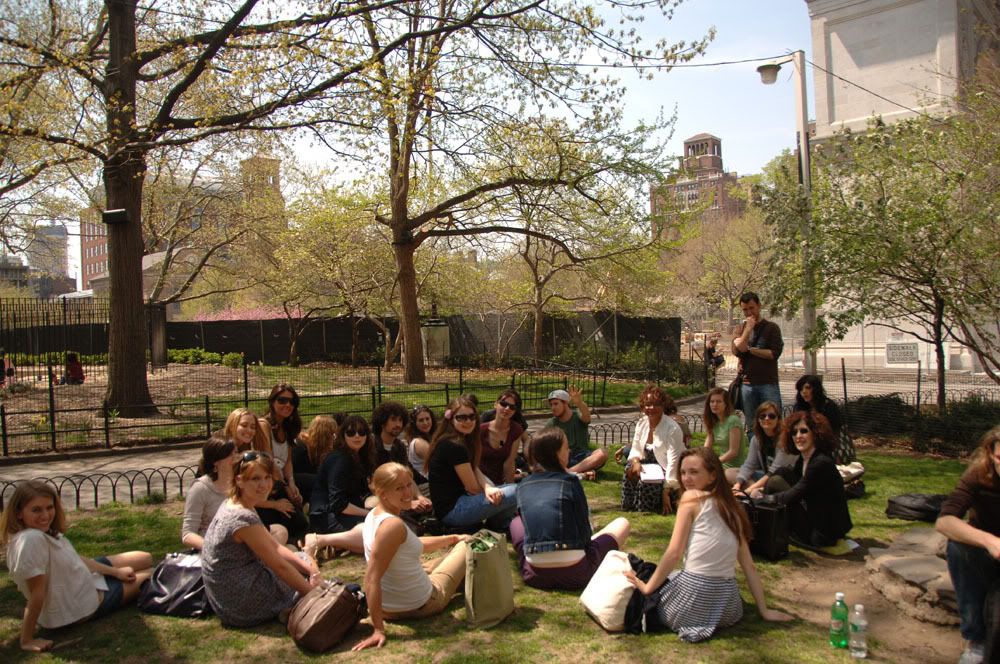
Tuesday, April 22, 2008
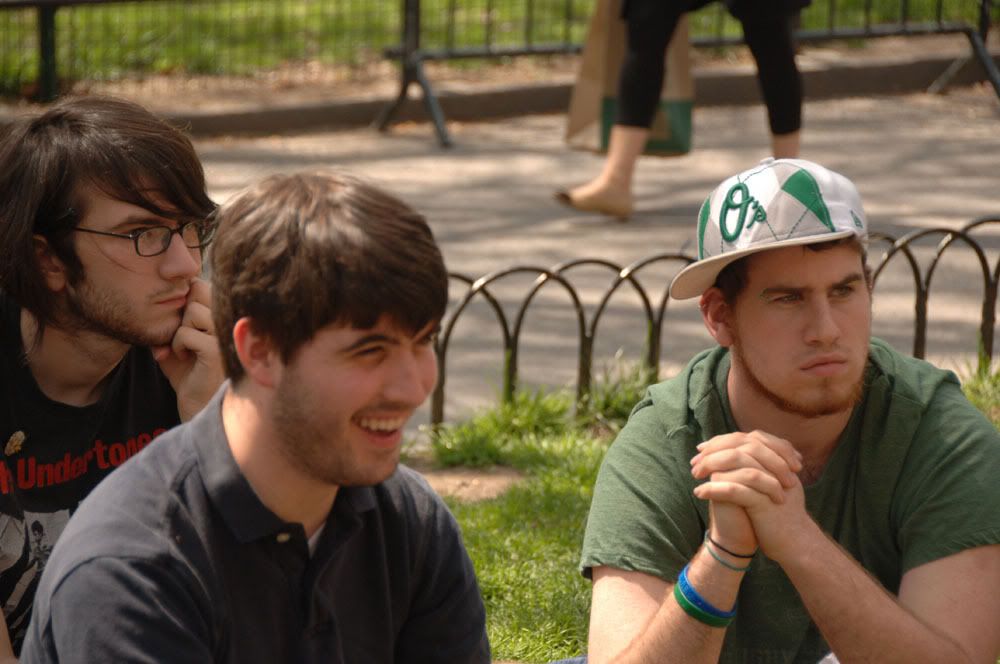
Three men in the park.
This is a copy of the "moment" that I did. I've forgotten it over and over again, but now that it's 1AM just before the last day it could possibly be put up, somehow I've remembered! Anyway, it is pretty minimalist, but try to picture it rather than thinking about if it has meaning or if it is a clever dialogue, because you won't find much there. It represents something I like about the park. That's all, really.
__________________________________________________
In
The man (1) with the guitar mutters incomprehensibly, offering also an occasional grunt.
The man with the hat (2) opens his mouth from time to time and looks like he’s about to say something, but remains otherwise quite still, with eyes half open, staring straight ahead.
The young Asian man (3) faces away from the man with the hat at an angle of about 90 degrees. He shifts in his seat multiple times and looks uncomfortable.
Man 3 (to Man 2): “Do you have a light?”
Man 2, without turning around or moving his head at all in any direction, reaches into his pocket, pulls out a small plastic butane lighter, and hands it to Man 3 over his left shoulder.
Man 3: “Thanks. I feel like I’m wasting my day.”
Man 3 lights a cigarette and hands the lighter back to Man 2.
Man 2: “Yeah.”
Man 3 (to Man 1): “What can you play?”
Man 1: “…”
Man 2: “I’ve never really heard him play much, just a few chords. I kind of feel like I’m wasting my day, too.”
Man 3: “I should have gone back to work a while ago.”
Man 2: “It is nice out, even if it isn’t sunny.”
Man 3: “I really need to stop taking such long lunch breaks. Do you have anywhere to be?”
Man 2: “Every year you think it’s going to be spring by now and it never is. Isn’t it funny how you always think that, and it never is?”
Man 3: “If I go back to work, though, I’m not going to get anything done. I may as well just stay out and tell everyone I felt sick. If I go back now, I’ll just get heckled for having been out.”
Man 2: “I heard it’s supposed to be nice later in the week at least.”
Man 3: “Either way, I guess I should go. I’m wasting my day.”
Man 2: “Me too.”
Man 3 (to Man 1): “Seeya later.”
Man 2 (to Man 1): “Take care.”
Man 1 continues to mutter and strum extremely slowly. The other two men get up and walk away, in the same direction, but a few feet apart.
The relationship between the three men remains completely ambiguous, as is the case with most apparent relationships between people sitting together at these picnic tables on any day of the year. The man continues to sit there with his guitar. He isn’t doing much, but he looks like he’ll be there for a while.
Window Project
My Hopper project is focused on interpretation. I took this photograph then went around and asked 20 different people what they thought was happening before/after/during this scene, then picked the best and put it together with the photograph.
Monday, April 21, 2008
Tamiment Library and Fales collection
My favorite part of visiting the library was actually documenting it. I took photos on professor Smith-Howard's camera of the students listening to the librarians speaking and I loved watching different people's reactions to the subjects being discussed. It was also really cool to see the old census books which I saw in both Tamiment and Fales Special Collections. It was cool to look up the old names and see things like Bishop the Blacksmith of 30 5th Avenue. It really helped me imagine what life was like back then. I also really enjoyed getting to see the old publications like the Massess. I wish that their were some more photographs, like original Kertesz's and original Hine, but most of those are owned by the NYPL and NYHS but I got to see them when I visited those places. I've never really been a big fan of the library and don't spend much time in it, but I did really enjoy going there with a purpose and focusing on a small piece. I dislike the library because I feel very intimidated by it and don't know where to start, so it was nice to take it on in small pieces.
Rebecca Ferguson
I really enjoyed Rebecca coming to our class, but my most valuable experience was meeting one on one with her. I met with her to do an interview about the dog park. She told me how the park has change and become a bit more, "yuppified." The coolest thing I thought she showed me was this map
http://www.nycgovparks.org/sub_your_park/washington_sq_park/reconstruction.php
everyone should check it out, it shows how the park will change over the next year with the construction.
I thought that it was really interesting that she was involved with the NYCPG because she came from and eco friendly background and NYC isnt always considered the most eco friendly. Overall I thought it was very cool hearing the insider perspective and think she was a really great person for anyone's project.
http://www.nycgovparks.org/sub_your_park/washington_sq_park/reconstruction.php
everyone should check it out, it shows how the park will change over the next year with the construction.
I thought that it was really interesting that she was involved with the NYCPG because she came from and eco friendly background and NYC isnt always considered the most eco friendly. Overall I thought it was very cool hearing the insider perspective and think she was a really great person for anyone's project.
More Observations...
This is a scribble that came out this weekend...watching musicians in the park...watching the people watching the musicians in the park...
the bench is always sitting
Felt
Rib after rib
He counted ever keystroke
Like a xylophone of sweat,
Mallet on a resonating
Vibrato
carol King
getting high on a Monday
kgb lovegames
pretentious peppermint patties
salacious grannies
physical conspirators
an editor
a singer
an intellectual
Write out the frequencies
And listen in between the static
To the drone of sonic
Bone rattle
the bench is always sitting
Window into the Square
Reflections on Washington Square Park - The lives
gazes burn bleaching through darkness
sharp stiletto heels piercing
through sponges
I must have fallen in love with the tyranny
the stage juts into crowds
but I’m alone
and standing
while you watch for
Madonna’s Jesus to rise
like bread on Passover
even though some questions
are never overheard in New York
and I’ll sing to you a Manishtanah
and you won't know what it means
so what makes you think that I
ever believed
in
this
everything radiates from the center
of something
repressed or otherwise
formalist sorts of fetishes
the way he falls on her
neck
the way he falls around her
waist
the ways he falls on her
falling
on her
downward and undressed
I think it was that first time
I realized you had
a Green soul
and that's the only reason
you were telling me to
turn the lights off
and not some sort of symbolism
so think I'll try out Bartelby's 'preferred'
and not pay heed
to judgments about
my pound of flesh
and whom i give it to
I'll carry my heart in a fishnet
perfumed with lavender
and something lonely
and we can stroll together
as long as we don't hold hands,
because that means too much
and I’ll stay in the third paragraph
of your religion
while you read ahead
because I’m not ready
and maybe I’ll never make it
in this young-ish antiquity
I’m ironing a blue ribbon
inside out
so that it comes out violet
like the sun
that's cancerous
see, i'm laughing because
even if it hurts,
irony is funny
because I hear pearls are bad luck
so maybe you should have
bought me flowers
and i would have loved you more
without the sex
Kerouac is dead
so there are no more secrets
creative post
here's a poem I wrote while sitting in the square earlier this semester,
sorry I haven't posted it until now:
Frosted Frankness
I watched the chiseled teeth of winter
bite into the apple of unknowing rouge,
tasting crunch and smelling silk cold shake,
hearing solitude in "will you drink my everything
with skim milk and two sugars?"
You're not from Brooklyn, Steven.
Your shirt's inside out
and you're going to take it off
when I smile "no".
It feels good pressing your
quiver between my quake
but it means as much as
insolence does
at the core
within this tart and spheric
gloss of human
drip.
sorry I haven't posted it until now:
Frosted Frankness
I watched the chiseled teeth of winter
bite into the apple of unknowing rouge,
tasting crunch and smelling silk cold shake,
hearing solitude in "will you drink my everything
with skim milk and two sugars?"
You're not from Brooklyn, Steven.
Your shirt's inside out
and you're going to take it off
when I smile "no".
It feels good pressing your
quiver between my quake
but it means as much as
insolence does
at the core
within this tart and spheric
gloss of human
drip.
Reaction: Fales Collection
We didn't go to Fales as a class, and due to other school related restraints I couldn't spend much time there, but the documents I did look through were really interesting. Fales has a great collection of materials relating to the NY downtown literary scene, but most of their stuff was from after the 50's and 60's, aka post-Beats. I spent most of my time browsing things that didn't have to do with my topic! I particularly enjoyed the Fashion Moda archive, which centered around the work of Stefan Eins and was a post-modern attempt to redefine the art medium.
I've also always been interested in sexual health so the Peter Lewis Allen collection of safe sex pamphlets was particularly fascinating for me. It was interesting to see how the notion of "safe sex" evolved over the past 30 years or so, and also the way that American society spoke about sex changed.
Despite the fact that Fales wasn't really relevant to my studies, I did enjoy my time there and I would highly recommend it for people seeking information on avant garde art and New York literary scenes post-dating 1975.
- Jessica Roy
I've also always been interested in sexual health so the Peter Lewis Allen collection of safe sex pamphlets was particularly fascinating for me. It was interesting to see how the notion of "safe sex" evolved over the past 30 years or so, and also the way that American society spoke about sex changed.
Despite the fact that Fales wasn't really relevant to my studies, I did enjoy my time there and I would highly recommend it for people seeking information on avant garde art and New York literary scenes post-dating 1975.
- Jessica Roy
Reaction: Tamiment Collection at Bobst
Though the small, windowless conference room really freaked me out, I found a lot of the documents passed around at our Tamiment meeting to be really interesting. I'm currently taking a course in NYC history so a lot of the stuff held resonance not only for WSP, but also for that class. The pictures of the Triangle Shirtwaist Factory fire served as both a disturbing jolt and a way to really put things into context for me. Knowing the history behind your area is so important; I literally take classes in a place where women could have died. Seeing the pictures really solidified that creepy, awful thought for me.
I also enjoyed seeing the copies of The Masses. As a Cultural Journalism concentration, I found it really enlightening to be able to hold in my hand a newspaper printed to rival big/yellow journalism and incite the underclasses to rise against maltreatment. Max Eastman is totally the Nick Denton of the early 1900s.
-Jessica Roy
I also enjoyed seeing the copies of The Masses. As a Cultural Journalism concentration, I found it really enlightening to be able to hold in my hand a newspaper printed to rival big/yellow journalism and incite the underclasses to rise against maltreatment. Max Eastman is totally the Nick Denton of the early 1900s.
-Jessica Roy
Exra - Finding the Band from the Park Again... - Grace
I saw the band I sang with last semester playing in the park a couple nights ago. My face lit up as I saw them strumming their guitars and I joined the crowd that was already formed around them. They were creating beautiful music once again and I couldn't help but stand there and smile. One of the guys saw me in the crowd and motioned me to come over. I gave them each a big hug and said how happy I was to see them again. The leader of the group asked me if I wanted to sing, and of course I said yes. We did another rendition of Georgia on My Mind and it was so much fun. I was on my way to a show and I couldn't stay for long, so I gave one of the band members my number and told him to call me up next time they were playing.
The next day, Nick, the main guitar player, told me he was having a little gathering of all the park musicians at his apartment that night. I felt a little wary about going because I hardly knew the guy, but I had a feeling the same sort of magic I felt in the park in the fall would be found at this gathering, and I knew I couldn't miss out. I went over to his house that night and as I opened the door to his apartment, I felt as though I was walking into a scene of a movie. The farely nice apartment was filled with these hippie musicians, all playing their instrument. When I walked in, the group was playing Judy Blue Eyes, complete with full harmonies and accompaniment. It was amazing and ridiculous and almost hilarious all at the same time. I saw all the guys from the band I sang with, plus ten other people, including one guy I was pretty sure was homeless. There was a guy in the corner with a long grey beard and hair playing the bongos, a bigger guy on the couch with earrings and tattoos playing the eukelele, and a couple flower child women sitting on the floor around the room. The group welcomed me in and invited me to sit down and relax. After singing along to amazing songs from the 60's, 70's, and 80's, they invited me to sing a solo. I sang You Don't Know Me by Ray Charles and Crazy by Patsy Cline. The musicians were so good and it was so fun to be there with them. We were all just in the moment and in the music and having the best time. I couldn't believe gatherings like this actually existed outside the movies. They called themselves "The Park Club" and I became an official member that night. I'll be returning to the Park Club soon.
The next day, Nick, the main guitar player, told me he was having a little gathering of all the park musicians at his apartment that night. I felt a little wary about going because I hardly knew the guy, but I had a feeling the same sort of magic I felt in the park in the fall would be found at this gathering, and I knew I couldn't miss out. I went over to his house that night and as I opened the door to his apartment, I felt as though I was walking into a scene of a movie. The farely nice apartment was filled with these hippie musicians, all playing their instrument. When I walked in, the group was playing Judy Blue Eyes, complete with full harmonies and accompaniment. It was amazing and ridiculous and almost hilarious all at the same time. I saw all the guys from the band I sang with, plus ten other people, including one guy I was pretty sure was homeless. There was a guy in the corner with a long grey beard and hair playing the bongos, a bigger guy on the couch with earrings and tattoos playing the eukelele, and a couple flower child women sitting on the floor around the room. The group welcomed me in and invited me to sit down and relax. After singing along to amazing songs from the 60's, 70's, and 80's, they invited me to sing a solo. I sang You Don't Know Me by Ray Charles and Crazy by Patsy Cline. The musicians were so good and it was so fun to be there with them. We were all just in the moment and in the music and having the best time. I couldn't believe gatherings like this actually existed outside the movies. They called themselves "The Park Club" and I became an official member that night. I'll be returning to the Park Club soon.
Extra- Grace "The Magic of the Park"
One amazing night last semester, after I got out of my 6-9pm music business class in Silver, I had this aching urge to sing. I knew, as I walked into the warm fall night, that if I didn't open my mouth and sing something good and soulful I might just explode. I called up my bandmate, Julian, to see if he would come meet me in a practice room, but he was already in his dorm and didn't want to come back to campus. I stood on Washington Square East and weighed my options. I could go to the practice room alone, but I didn't play piano very well and really wanted to sing with a good musician. I could go home and hope the urge to make some music would subside, but I knew that couldn't happen. I decided I would walk through the park towards fifth avenue and see if there were any players strumming their guitars. I thought maybe I could listen for a while and then ask to sit in on some songs. As I walked through the park, the night getting darker, I spotted three old men sitting and playing music on one of the stone circles around a tree. Two were on guitar and one was playing a drum. My breath quickened a little and my excitement grew as I sped up my walking towards the three old hippies. They were playing a "Here Comes the Sun" and didn't care that noone was watching them. I stood off to the side a little and watched for almost ten minutes. I bopped my head and danced a little as they played their tunes. Finally, after I felt as though they had accepted me as a "cool audience member" I asked if I could sing a song with them. The leader of the group happily said "sure sweetie, what do you know?" I asked if they could play Georgia on My Mind in the key of C. They started up a cool, slow beat and I sank into the music. I opened my mouth and let out the music I had been bursting to release. Slowly, a little crowd started forming around us. More and more people started stopping and listening and soon we had a good size crowd listening to our little concert. We played more songs we all knew and I felt a high I only feel when I'm performing. It was different than any other performance high I've ever gotten however, because the whole moment felt so organic and beautiful. There was this magic in the park that night and we all felt it. I suggested we play "Imagine" by the Beatles, and as we started, the crowd began to sway and sing along. It was an incredible experience. I felt so connected to all these people I had never spoken to in my life. We were all united in music. It was absolutely amazing. I left the park that night feeling like I could cry with happiness. I felt so full of life and so full with the beauty of art all I could do was spread my arms out in the air and feel the wind pass over me as I walked up fifth avenue. It's moments like that, it's places like Washington Square Park, that make me realize why I really love New York City.
Window on the Square - Grace Weber
I loved the window on the square assignment. In fact, I loved it so much, that it inspired me to do my final project on Edward Hopper! The painting that I did for the actual assignment was of my friend, Melanie. I was trying to emulate looking through a window of Goddard Hall, an NYU dorm on the square. I painted Melanie laying in her dorm room bed, looking off at something. I wanted to let the viewer decide what she was looking at, whether it was another person, the TV, outside, or anything else. It also kind of looks like she's sleeping in the picture, so maybe a viewer might take that as she is just going to sleep or she is just waking up, maybe from a nap.
I also started another painting, but never finished it, of this house on 9th street. I went to go find it after Michael Levy talked about it in class that one day. The apartment is crazy. It's this apartment on the first floor of the building, and there are two big long windows on the left and then one shorter one on the right. When I found the apartment, I saw half of an old man's head in the far right small window, a huge elegant chandeleir in the middle long window, and a huge bird cage with a blue parrot sitting on top in the far left window. It was one of the creepier apartments I've ever seen. The old man was hunched over what looked like a drawing desk, and I pictured him as an illustator, drawing semi-creepy illustrations for weird children's books. This guy just loves displaying his parrot, and the parrot loves staring down strangers as they walk past on the street. It was funny to see people notice the bird, step back, and then either laugh or get a really freaked out look on their face. The bird just sits on his bar, staring. Once in a while he'll walk slowly to the other side of his perch, ruffle his feathers a little, and then resume his post. He's kind of like a watch-dog, but instead of barking at intruders he just gives them a warning stare and taps his sharp claws on the metal cage, until the intruder slowly backs away.
The bird's name is Lord Rescheller the First.
I also started another painting, but never finished it, of this house on 9th street. I went to go find it after Michael Levy talked about it in class that one day. The apartment is crazy. It's this apartment on the first floor of the building, and there are two big long windows on the left and then one shorter one on the right. When I found the apartment, I saw half of an old man's head in the far right small window, a huge elegant chandeleir in the middle long window, and a huge bird cage with a blue parrot sitting on top in the far left window. It was one of the creepier apartments I've ever seen. The old man was hunched over what looked like a drawing desk, and I pictured him as an illustator, drawing semi-creepy illustrations for weird children's books. This guy just loves displaying his parrot, and the parrot loves staring down strangers as they walk past on the street. It was funny to see people notice the bird, step back, and then either laugh or get a really freaked out look on their face. The bird just sits on his bar, staring. Once in a while he'll walk slowly to the other side of his perch, ruffle his feathers a little, and then resume his post. He's kind of like a watch-dog, but instead of barking at intruders he just gives them a warning stare and taps his sharp claws on the metal cage, until the intruder slowly backs away.
The bird's name is Lord Rescheller the First.
I love the Judson - Grace Weber
I think the Judson Church has the right idea about religion. I love their description of the church on their website:
"You've found a church that's a little bit different. It looks like a high Italian Renaissance church for a reason you might not expect from low church Baptists.
We're deeply rooted in free church, Baptist and UCC traditions, but every kind of believer and not-so-much-a believer gathers together on Sunday mornings. We've been Gay Proud long before Gay Pride.
We're interested in changing the plight of the marginalized and noticing when the emperors have no clothes. We think the arts make life worth living and celebrate the secular and sacred in all that we do, including worship and how we use our glorious spaces."
I grew up in the Catholic Church, going to a Catholic grade school and high school. I was confirmed in the religion, only because I wanted to go through the process of learning more about the religion before deciding that I didn't want to be a part of it anymore. I thought, well, I'll just go to the confirmation classes and then decide how I feel about catholicism. On the day I got confirmed, I turned to my mom and said, "I do not want to be a part of the Catholic Church". I got confirmed that day anyways, just because my grandma was there and I knew it would make her happy. I could have cared less as the priest put the oil on my forehead. I was slowly growing more and more angry with the church, after dealing with horribly mean nuns, hipocritical parish members, and the close-minded views of most catholics, including the idea that homosexuality is wrong. The sex abuse scandal pushed me over the edge. I was so disgusted with everything about the Catholic Church, that I found myself loosing faith in religion in general. I haven't gone to church since I was a senior in high school, I've prayed maybe once since then, and when I see "I love Jesus" t-shirts I couldn't be more annoyed.
Going to the Judson church re-ignited my faith in religion. I was so refreshed to find out they supported gays and welcomed all types of believers and non-believers. I think Jesus wanted his church to be like the Judson, not a place where only certain kinds of people are welcome. It's absolutely amazing that the Judson Church, church being a word that is most always associated with conservatism, has been a leader in the march of liberalism and freedom for all types of people since its creation in 1890. I think it's ridiculously cool that the Juson holds performances, dances, concerts, and different art showcases in its space. I am thinking of attending mass there one of these days to see what it's like. I may even join because although I never want to be a part of organized religion again, I would love to be a part of a loving community of liberal people who have the same morals as I. I love the Judson Church.
"You've found a church that's a little bit different. It looks like a high Italian Renaissance church for a reason you might not expect from low church Baptists.
We're deeply rooted in free church, Baptist and UCC traditions, but every kind of believer and not-so-much-a believer gathers together on Sunday mornings. We've been Gay Proud long before Gay Pride.
We're interested in changing the plight of the marginalized and noticing when the emperors have no clothes. We think the arts make life worth living and celebrate the secular and sacred in all that we do, including worship and how we use our glorious spaces."
I grew up in the Catholic Church, going to a Catholic grade school and high school. I was confirmed in the religion, only because I wanted to go through the process of learning more about the religion before deciding that I didn't want to be a part of it anymore. I thought, well, I'll just go to the confirmation classes and then decide how I feel about catholicism. On the day I got confirmed, I turned to my mom and said, "I do not want to be a part of the Catholic Church". I got confirmed that day anyways, just because my grandma was there and I knew it would make her happy. I could have cared less as the priest put the oil on my forehead. I was slowly growing more and more angry with the church, after dealing with horribly mean nuns, hipocritical parish members, and the close-minded views of most catholics, including the idea that homosexuality is wrong. The sex abuse scandal pushed me over the edge. I was so disgusted with everything about the Catholic Church, that I found myself loosing faith in religion in general. I haven't gone to church since I was a senior in high school, I've prayed maybe once since then, and when I see "I love Jesus" t-shirts I couldn't be more annoyed.
Going to the Judson church re-ignited my faith in religion. I was so refreshed to find out they supported gays and welcomed all types of believers and non-believers. I think Jesus wanted his church to be like the Judson, not a place where only certain kinds of people are welcome. It's absolutely amazing that the Judson Church, church being a word that is most always associated with conservatism, has been a leader in the march of liberalism and freedom for all types of people since its creation in 1890. I think it's ridiculously cool that the Juson holds performances, dances, concerts, and different art showcases in its space. I am thinking of attending mass there one of these days to see what it's like. I may even join because although I never want to be a part of organized religion again, I would love to be a part of a loving community of liberal people who have the same morals as I. I love the Judson Church.
Rebecca Ferguson - Grace Weber
I thought Rebecca Ferguson was pretty cool. She seemed so down to earth and chill, it was nice to listen to her talk. She did seem a little stressed out as well, but who wouldn't be with all that she has to deal with. I got this feeling from her that she wished she wasn't in charge of this whole park renovation. It felt like she didn't even realize what a big deal the whole thing was going to be. She seemed almost detached a little, like she needed to keep a distance because if she got to emotionally invovled it would be way too hard. On the other side of it, however, I do think she felt she was the strongest woman for the job and probably likes the challenge. Because she said that she was this "insider" for the "good guys" almost, I wondered if she feels as though she is betraying the "good guys" in a way almost.
I thought Rebecca did a fine job talking to us about the park, but I got the vibe that she was sooo sick of talking about the issue again. There's obviously not much she can about stopping the rennovation now, so it must be really hard for her to deal with people continuing to complain about it. I think that everything with the park will turn out fine. I think musicians will still play in the park, homeless people will still sleep there, and drugs will probably still be dealt there. I am very frustrated that they didn't just do small repairs here and there instead of tearing up the whole park, but I'm sure in the end everyone will be happy.
I thought Rebecca did a fine job talking to us about the park, but I got the vibe that she was sooo sick of talking about the issue again. There's obviously not much she can about stopping the rennovation now, so it must be really hard for her to deal with people continuing to complain about it. I think that everything with the park will turn out fine. I think musicians will still play in the park, homeless people will still sleep there, and drugs will probably still be dealt there. I am very frustrated that they didn't just do small repairs here and there instead of tearing up the whole park, but I'm sure in the end everyone will be happy.
Tamiment - Grace Weber
The Tamiment Library was one of my favorite class visits as far as being educationally stimulated. I had been searching online for information about the Masses magazine and hadn't really found anything good before going to the Tamiment, so I was extremely excited when a real live Masses magazine was pulled out of the box! I stayed after to look through one of the books with a large collection of Masses issues in it, and I had so much fun reading through the pages. I had read somewhere that the Masses was one of the most well-designed magazine of its time, so I was interested to see how the pages were laid out and how they handeled art work within the magazine and everything. I was also very interested in seeing what the writing style was like and how "news stories" were told. I found it interesting that most of the news was told in story-like form. It was very dramatic writing and some of the stories almost reminded me of a soap opera. I wondered if the stories were actually true. I realized that there may be a strong possibilty that some of the stories were not true, and instead were made-up stories intended to make commentary on controversial events or issues that were going on at the time. Considering that the Masses whole intended purpose was to speak out on the social issues of the time, and to do that in a creative and sometimes comical way, having made up stories within the magazine would make sense. Of course, I would have to research that idea more to actually say that is what they did.
I also thought the two librarians at the Tamiment did a great job presenting the information to us. They were excited about the ephemera and other items they had and they were passionate about sharing their knowledge with us. I thought they picked out things that would relate well to us and could potentially help us with our final projects. I loved when the woman librarian (i forgot her name!) pulled out those awesome posters from the 60's and 70's and I think from recent times as well. They were so beautiful and I thought it was so cool that they were preserving them at the Tamiment.
I also thought the two librarians at the Tamiment did a great job presenting the information to us. They were excited about the ephemera and other items they had and they were passionate about sharing their knowledge with us. I thought they picked out things that would relate well to us and could potentially help us with our final projects. I loved when the woman librarian (i forgot her name!) pulled out those awesome posters from the 60's and 70's and I think from recent times as well. They were so beautiful and I thought it was so cool that they were preserving them at the Tamiment.
Fales - Grace Weber
I thought Fales was ok, not the most exciting. My favorite part about the presentation was the guy who gave it to us. He seemed like he was a guy with a pretty dry sense of humor, i liked it. I thought he did a great job laying out the books on the table for us, putting them in chronological order and everything. I was suprised to see how many relatively recent books they had from the village area. I guess most times when I go look at a library's special collections (like I do it all the time) I expect to see these old, decaying books from the 1700's. When he pulled out the books from the 80's and even 90's, I realized that they are collecting pieces of history every day. It was crazy to think what kids 100 years from now will think when they look at a book from 2008 and describe it as "old and decaying".
Final Project, Extra, Hopper - Grace Weber
As a visual art student, I have spent a lot of time analyzing art pieces. In nearly all of my art classes, we have taken some time to turn on the projector, pull down the screen, hit the lights, and examine famous pieces relevant to our current focus. During these classes, we will usually discuss how the artist works with color, light, composition, and any conceptual ideas we think the artist is trying to portray. I often wonder, however, as I listen to one of my classmates explain her reasoning for why she thinks the purple flower vase in the back of the painting represents the artist’s secret double gay life, whether or not these revered artists were really meaning to have their works analyzed so deeply. Do we over-analyze art to a point where we sometimes lose the beautiful simplicity of their being, or are we simply drawing our own conceptual ideas out of the work, allowing us to connect with it in a more personal way?
I remember the day when Edward Hopper’s paintings came onto the screen. Hopper, one of the most famous American realist painters of 1900’s, began his painting career at the New York School of Art, studying there from 1901-1906. He continued painting in New York until his death in his home on Washington Square in 1967. His style of painting seems to emanate from his own personality, which according to friends was one of solitude and deep inwardness. Besides being acclaimed for representing the almost “heroic plainness of American life” (Lyons, 9), his paintings are most well known for the introspective and often lonely moods they create. In our class that day, we looked at the ways in which Hopper created these moods in his paintings, through his dramatic use of color, light, and shadows. We discussed how his use of bright, almost electric green in his Room in New York, 1932 helps to create a mood of tension between the couple featured in the painting, without making the two people seem obviously upset or angry themselves. We continued to analyze the painting, discussing such things as the compositional choice to put the door in between the couple, creating more separation and thus tension between the two.
And yet as we took apart this Hopper painting, again I couldn’t help but think that maybe we were analyzing the piece too deeply. That perhaps Hopper, an artist known for his plainness and his simplistic approaches to paintings, was only trying to portray a scene, not set up secret symbols within the piece.
One of my favorite art professors once said, “A brilliant artist can leave their piece open for interpretation, allowing the critique to pull themes and ideas from it that the artist may have never intended.” I was a little confused when I first heard this statement, unsure of what exactly he meant. But then, he applied the idea to music and poetry, my first loves. He explained that many times a poet may write a poem with a specific idea in mind, but when that idea is able to resonate differently and personally in the souls of each individual, then it is real art. I thought about certain songs that I love, songs with poetry that allows me to visualize my own story as the melody flows through my body. I love being able to connect with music and poetry on a personal level, I love being able to analyze the meanings in my own way, so why can’t the same feelings be true for analyzing visual art?
When I think about Hopper’s paintings, leaving space open for interpretation is exactly what he intended to do. The deeper I examined my questions about over-analyzing the work, I realized that maybe Hopper wanted his audience to do that, to search within his pieces and find their own personal meaning and connection. Of course, I do think he intends to set up a specific mood as well through his obvious theatrical color and light choices, and I think he may even have made certain compositional choices to delicately lead the viewer to a certain conclusion. His strongest aspect of his artistry, however, was his ability to create these ambiguous and simple, yet incredibly deep and introspective scenes in his work. He doesn’t just paint a realist scene, though, for if that was all it was it would not have the ability to resonate so differently in each individual’s soul. Instead, he sets up a story, then allows the viewer to enter in and experience the painting for themselves. He lets you stand in the light or the shadow, find the happy or the sad. Most of all, he lets you create your own narrative.
I admire Hopper for his ability to create subtle, but not definite stories in his work. Even in his Sun in an Empty Room painting, one cannot help but wonder what happened in that room just before the moment he portrays and what will happen in it later? The room itself almost gains a personality. For me, the loneliness of the room almost makes me feel sympathetic towards it. An artist who can make you feel bad for an empty room, is powerful.
In my own art project, I attempted to emulate Hopper’s paintings by exploring my own abilities to create these indefinite but moody scenes and stories. I focused on relationships between people, as well as on the effect that light has on the mood of a painting. I tried to paint my subjects with as little expression as possible, and yet still create an undertone of deep thought within their bodies and faces. I wanted to make my relationships somewhat unclear, however still leaving space for deep interpretation, versus just creating a boring representation of a human being. Although an extremely difficult thing to master, I feel I made some progress in creating several “real” art pieces. I thank Edward Hopper for giving me the inspiration to pursue this project and I will to continue to explore how the elements of light, composition, and color can affect the mood and narratives of my paintings. I do think, however, that Hopper had a special gift, something that went far beyond light, composition, and color. This gift allowed him to paint with a unique passion that can only be described through a unique and inward feeling. I will forever walk through Hopper’s paintings, run my hands down the sides of his buildings, and create my own story.
I remember the day when Edward Hopper’s paintings came onto the screen. Hopper, one of the most famous American realist painters of 1900’s, began his painting career at the New York School of Art, studying there from 1901-1906. He continued painting in New York until his death in his home on Washington Square in 1967. His style of painting seems to emanate from his own personality, which according to friends was one of solitude and deep inwardness. Besides being acclaimed for representing the almost “heroic plainness of American life” (Lyons, 9), his paintings are most well known for the introspective and often lonely moods they create. In our class that day, we looked at the ways in which Hopper created these moods in his paintings, through his dramatic use of color, light, and shadows. We discussed how his use of bright, almost electric green in his Room in New York, 1932 helps to create a mood of tension between the couple featured in the painting, without making the two people seem obviously upset or angry themselves. We continued to analyze the painting, discussing such things as the compositional choice to put the door in between the couple, creating more separation and thus tension between the two.
And yet as we took apart this Hopper painting, again I couldn’t help but think that maybe we were analyzing the piece too deeply. That perhaps Hopper, an artist known for his plainness and his simplistic approaches to paintings, was only trying to portray a scene, not set up secret symbols within the piece.
One of my favorite art professors once said, “A brilliant artist can leave their piece open for interpretation, allowing the critique to pull themes and ideas from it that the artist may have never intended.” I was a little confused when I first heard this statement, unsure of what exactly he meant. But then, he applied the idea to music and poetry, my first loves. He explained that many times a poet may write a poem with a specific idea in mind, but when that idea is able to resonate differently and personally in the souls of each individual, then it is real art. I thought about certain songs that I love, songs with poetry that allows me to visualize my own story as the melody flows through my body. I love being able to connect with music and poetry on a personal level, I love being able to analyze the meanings in my own way, so why can’t the same feelings be true for analyzing visual art?
When I think about Hopper’s paintings, leaving space open for interpretation is exactly what he intended to do. The deeper I examined my questions about over-analyzing the work, I realized that maybe Hopper wanted his audience to do that, to search within his pieces and find their own personal meaning and connection. Of course, I do think he intends to set up a specific mood as well through his obvious theatrical color and light choices, and I think he may even have made certain compositional choices to delicately lead the viewer to a certain conclusion. His strongest aspect of his artistry, however, was his ability to create these ambiguous and simple, yet incredibly deep and introspective scenes in his work. He doesn’t just paint a realist scene, though, for if that was all it was it would not have the ability to resonate so differently in each individual’s soul. Instead, he sets up a story, then allows the viewer to enter in and experience the painting for themselves. He lets you stand in the light or the shadow, find the happy or the sad. Most of all, he lets you create your own narrative.
I admire Hopper for his ability to create subtle, but not definite stories in his work. Even in his Sun in an Empty Room painting, one cannot help but wonder what happened in that room just before the moment he portrays and what will happen in it later? The room itself almost gains a personality. For me, the loneliness of the room almost makes me feel sympathetic towards it. An artist who can make you feel bad for an empty room, is powerful.
In my own art project, I attempted to emulate Hopper’s paintings by exploring my own abilities to create these indefinite but moody scenes and stories. I focused on relationships between people, as well as on the effect that light has on the mood of a painting. I tried to paint my subjects with as little expression as possible, and yet still create an undertone of deep thought within their bodies and faces. I wanted to make my relationships somewhat unclear, however still leaving space for deep interpretation, versus just creating a boring representation of a human being. Although an extremely difficult thing to master, I feel I made some progress in creating several “real” art pieces. I thank Edward Hopper for giving me the inspiration to pursue this project and I will to continue to explore how the elements of light, composition, and color can affect the mood and narratives of my paintings. I do think, however, that Hopper had a special gift, something that went far beyond light, composition, and color. This gift allowed him to paint with a unique passion that can only be described through a unique and inward feeling. I will forever walk through Hopper’s paintings, run my hands down the sides of his buildings, and create my own story.
Sunday, April 20, 2008
Judson
Before we visited Judson Chuch, I walked by there every day and never took a second glance. It was just another church. Nothing interesting. Then we heard about how Judson opened their doors to everyone during the folk singer riot. I was impressed by the nice gesture they made towards those being exiled from the park. When we looked at the main church space I thought "wow you could totally put bands in here" (no... I really did). After a bit of leisurely googleing, I found out Judson has been super supportive of the arts for decades! They hosted art shows, plays and BANDS, most of which were leftist and controversial. And apparently Arcade Fire played there last year... way for me to not know!!! In retrospect, after all we've read and heard, I don't know why I was floored to find out that another building along Washington Square Park helped mold its “artists’ refuge” reputation.
Saturday, April 19, 2008
WASHINGTON SQUARE: APRIL 1ST.
ten to four walked in on the east side while
the west side’s for leaving when the subway’s coming
and I try to not decide what I’m writing anymore
saw some guy who I’m supposed to be friends with
and walked past him without a pleasantry, please
ominous is pretentious, I write, but the sky walks away
in degrees of humidity and the different colors of gray
and all the excavated mud smells its way to this bench.
at the point of geribaldi’s sigh he holds his sword
and turns his back on the whole boring conversation
we’re all trying to ignore each other, he remembers under
the green on the tree tips and the church steeple stands up
against the gray rain and brown gravel, the benches
just blend into the blandness of the rest of it since
spring’s still not bold enough to hold the handle of it yet.
school boys wander past with cold coffee cups
looking for the kind of girls who flick their cigarettes
talking across the country laughing with ashes in their eyes
waiting in scarves deciphering a lady who sits alone
she’s accidentally across the path with books and pencils
but no one’s got their eyes on the pages anymore
and our humid hair curls around our faces over damp jackets.
the plastic sunglasses sleep on her head, her eyes staring
and sometimes the words are written misspelled when you
look up there in the bell tower, the rows of railings are vacant
like the knee high iron fences stationary and infectious
that’s what its like here on april fool’s day bored by
the time keeper who sits constantly counting the minutes
to the next hour, secretly over her shoulder.
-nicole wallace.
ten to four walked in on the east side while
the west side’s for leaving when the subway’s coming
and I try to not decide what I’m writing anymore
saw some guy who I’m supposed to be friends with
and walked past him without a pleasantry, please
ominous is pretentious, I write, but the sky walks away
in degrees of humidity and the different colors of gray
and all the excavated mud smells its way to this bench.
at the point of geribaldi’s sigh he holds his sword
and turns his back on the whole boring conversation
we’re all trying to ignore each other, he remembers under
the green on the tree tips and the church steeple stands up
against the gray rain and brown gravel, the benches
just blend into the blandness of the rest of it since
spring’s still not bold enough to hold the handle of it yet.
school boys wander past with cold coffee cups
looking for the kind of girls who flick their cigarettes
talking across the country laughing with ashes in their eyes
waiting in scarves deciphering a lady who sits alone
she’s accidentally across the path with books and pencils
but no one’s got their eyes on the pages anymore
and our humid hair curls around our faces over damp jackets.
the plastic sunglasses sleep on her head, her eyes staring
and sometimes the words are written misspelled when you
look up there in the bell tower, the rows of railings are vacant
like the knee high iron fences stationary and infectious
that’s what its like here on april fool’s day bored by
the time keeper who sits constantly counting the minutes
to the next hour, secretly over her shoulder.
-nicole wallace.
Wednesday, April 16, 2008
Response to another post -
I'm already going to get less sleep than I need tonight, so I'll hold off on my comments about our visit to Judson Memorial Church, which I greatly enjoyed, but I wanted to respond, before I forget, to Phil's bit about Eric Cartmill's presentation.
I thoroughly enjoyed the presentation based on the merits of the performance, but completely agree with the sentiment that focusing too much on the possibilities of a work takes away from our ability to appreciate its realities. Furthermore, while it is particularly tempting to assess the narrative potential of Hopper's paintings because his subjects are so prosaic, let's not forget that all art is ambiguous, whether it wants to be or not.
Robert Frost's "The Road Not Taken" is probably the most grossly misinterpreted thing in the history of art of any kind. In general, writers, musicians, painters, filmmakers, and artists of all other kinds choose to leave their work open to interpretation, but people have misinterpreted Frost's work so badly from the day of its initial publication that the poet himself actually took explicit pains to publicly declare his fans wrong. In spite of his efforts, the misinterpretations prevail even today.
Don't get me wrong - I like the openness of Hopper's work, but not only is it all too easy to forget what it is by focusing too heavily on what it is not - it is also too easy to overlook the fact that all art has a beginning and an end, and therefore a lost time before and after. Songs and stories might give ten minutes or ten years, where as a painting might give one infinitesimally small fraction of a moment in time, but there is always missing context for us to wonder about. Most artists, I presume, are aware of this, as I'm sure Hopper was. That is why I second the argument that there is undoubtedly some value in what Hopper, or any other painter for that matter, is trying to show his audience, and it is important not to neglect that.
That being said, it can be fun to imagine, and I have to say that I was absolutely blown away by some of the stuff that people have done for these "windows" projects; and I've been in an unusually cynical mood these last couple of months, so I think that's saying something. Seriously, some of that stuff has really just been incredible. Okay, Judson stuff later. 'Nite.
--Jonny
I thoroughly enjoyed the presentation based on the merits of the performance, but completely agree with the sentiment that focusing too much on the possibilities of a work takes away from our ability to appreciate its realities. Furthermore, while it is particularly tempting to assess the narrative potential of Hopper's paintings because his subjects are so prosaic, let's not forget that all art is ambiguous, whether it wants to be or not.
Robert Frost's "The Road Not Taken" is probably the most grossly misinterpreted thing in the history of art of any kind. In general, writers, musicians, painters, filmmakers, and artists of all other kinds choose to leave their work open to interpretation, but people have misinterpreted Frost's work so badly from the day of its initial publication that the poet himself actually took explicit pains to publicly declare his fans wrong. In spite of his efforts, the misinterpretations prevail even today.
Don't get me wrong - I like the openness of Hopper's work, but not only is it all too easy to forget what it is by focusing too heavily on what it is not - it is also too easy to overlook the fact that all art has a beginning and an end, and therefore a lost time before and after. Songs and stories might give ten minutes or ten years, where as a painting might give one infinitesimally small fraction of a moment in time, but there is always missing context for us to wonder about. Most artists, I presume, are aware of this, as I'm sure Hopper was. That is why I second the argument that there is undoubtedly some value in what Hopper, or any other painter for that matter, is trying to show his audience, and it is important not to neglect that.
That being said, it can be fun to imagine, and I have to say that I was absolutely blown away by some of the stuff that people have done for these "windows" projects; and I've been in an unusually cynical mood these last couple of months, so I think that's saying something. Seriously, some of that stuff has really just been incredible. Okay, Judson stuff later. 'Nite.
--Jonny
window assignment (3 extra)
Picture: Across the corridor looking through large glass windows lives in elderly woman. She sits in a large green chair as she watches a small television on the opposite side of the room. Beige carpet, beige walls, and a beige lamp surround her. Everything is beige.
Scenario 1:
The elderly woman across the shaft sits and watches her television shows like clockwork. Every evening at 9pm she sits in her green chair, remote in hand, watching her favorite television show. She never misses an evening, never changing her patter, and always alone. As she sits and watches her show she never laughs and never smiles, just blankly stares as reflections of light from the television dance across her face.
She sits and she thinks about all the years’ gone bye. How the studio apartment she moved into 50 years ago was never meant to be permanent, but a place where she would pass the time until she met her true love. She thinks of all the happiness she has missed out on, children, a husband, a family, and a life less lonely. She thinks of all the dreams she once had and never fulfilled. She thinks of how alone she is and how her life has become completely beige.
Scenario 2:
The elderly woman across the shaft sits and watches her television like clockwork. Every night at 9pm she watches a classic movie that makes you realize how amazing movies once were. Movies from the 1930’s and 1940’s, filled with Hollywood glamour and couture. As she watches the movies she thinks about all the fun her and her friends had making the films. The dresses they wore, the parties they went to, and the fact that it was the best time she ever had in her whole life.
Now that the years have gone bye, all she has are the movies. Through the movies she can see her old friends and remember all the good times. It is her favorite time of day.
Catherine Gargan
Scenario 1:
The elderly woman across the shaft sits and watches her television shows like clockwork. Every evening at 9pm she sits in her green chair, remote in hand, watching her favorite television show. She never misses an evening, never changing her patter, and always alone. As she sits and watches her show she never laughs and never smiles, just blankly stares as reflections of light from the television dance across her face.
She sits and she thinks about all the years’ gone bye. How the studio apartment she moved into 50 years ago was never meant to be permanent, but a place where she would pass the time until she met her true love. She thinks of all the happiness she has missed out on, children, a husband, a family, and a life less lonely. She thinks of all the dreams she once had and never fulfilled. She thinks of how alone she is and how her life has become completely beige.
Scenario 2:
The elderly woman across the shaft sits and watches her television like clockwork. Every night at 9pm she watches a classic movie that makes you realize how amazing movies once were. Movies from the 1930’s and 1940’s, filled with Hollywood glamour and couture. As she watches the movies she thinks about all the fun her and her friends had making the films. The dresses they wore, the parties they went to, and the fact that it was the best time she ever had in her whole life.
Now that the years have gone bye, all she has are the movies. Through the movies she can see her old friends and remember all the good times. It is her favorite time of day.
Catherine Gargan
Three extra entries
These are my reactions to the first three sets of readings from our class.
Number 1:
The most important theme that resonates throughout these articles is that of the subversive nature of Washington Square Park. The park began as a symbol of wealth, as indicated in Henry James’ famous novel Washington Square. However, as Greenwich Village began to become infiltrated by artists and musicians seeking a way of life that differed from the mainstream, the park became the centralized location for all of their subversive actions.
For years, Washington Square Park has come to symbolize subculture and creativity in ways that other locations in New York never could. It is the quintessential symbol for all things bohemian: artistic movements, music, drugs, and a general apathy towards the societal system at hand. Beginning with Robert Henri and his artistic following in the early 1900’s, and continuing on through the 60’s with Bob Dylan and The Velvet Underground, the park itself has become both a physical and metaphorical place ripe with anti-establishment notions.
The importance of this subculture in New York’s artistic and literary history introduces another important theme that arose in these readings: the distinct desire of the educated population to preserve everything the park stands for, and not let it fall into the hands of the establishment that the artists who made it a bohemian paradise fought so strongly against.
As a student at NYU, I am torn between wanting to adopt the park as part of my campus, but also appreciating it for its historical and artistic importance. I understand the desire of the people who have settled in Greenwich Village to protect it from the growing encroachment of NYU’s expansion endeavors. However, I do believe there is a middle ground; I think that middle ground was crossed when New York City decided to revamp the park.
In the past, NYU has done a good job in maintaining the natural look and feel of the park. Its diversity is wholly appealing to me in so many ways; there are drug dealers and students and businessmen and homeless people who all mix together to enjoy the park experience. I believe that by redoing the park, something is lost. Unfortunately, I don’t believe any of us will be able to articulate what exactly that is until the restoration process is completed.
What started as something subversive and bohemian may end up falling into the clutches of the very establishment that the park’s early champions despised. The important part is that we remember what the park stands for, even if its physical appearance changes. Its history of art and music is something that cannot be repaved.
Number 2:
The archaeological report on the previous and upcoming renovation projects on historical Washington Square Park brings to light the park’s dark and fascinating history. Once a graveyard called Potter’s field, thousands of bodies lay beneath it, having decomposed while the park changed hands between various wealthy private investors. The archaeological report attempts to deconstruct this complicated financial history in an effort to understand which parts of the park should be preserved during the renovation.
This is important because it stands as a blatant attempt at compromise between the two sides fighting over Washington Square Park’s future. By doing copious amounts of research in order to determine which parts of the park are the most sacred, the politicians in charge are reaching out a hand to the public who wishes for the park to remain in tact so as to preserve its rich cultural history. If the renovators of the park can retool it to make it a nicer place to be, while still preserving its natural history and important areas, then perhaps these two sides can reach an agreement.
The people against the renovation of the park cite primarily its rich cultural history as their main motive for wanting to keep it the same. The park has always been a center of subversive behavior, as demonstrated in “Max Eastman and The Masses” from Republic of Dreams by Ross Wetzsteon. The Masses was a political and social publication that combined ideas of anarchism, communism, socialism and general apathy towards the mainstream in order to galvanize support from fringe artists and writers to fight for the counterculture. The Masses represents the importance of Washington Square in beginning to construct a counterculture that eventually blossomed into the mainstream with musicians such as Bob Dylan and the Velvet Underground and artists like Andy Warhol.
Though The Masses was eventually shut down by governmental organizations, and though its popularity never skyrocketed due to its confused focus and theses, it still serves as an interesting representation of the growing counterculture movements in the early 20th century.
Number 3
Chapter 4 of Republic of Dreams was extremely interesting for me, especially because I am working on an independent study project this semester that examines feminism and subculture in the media. One of the disappointing things about the subculture that emerged from Washington Square Park was the seeming lack of female participation. That, coupled with the way women are treated in Jack Kerouac’s On the Road, presents a grim outlook for women of the anti-establishment movement.
But Republic of Dreams tells a different story that paints women in a much more favorable light. Many different women played roles in developing the subculture movements around the park in the 1910’s: whether it be from disseminating information on birth control and free love, dressing differently to avoid female dress stereotypes, or holding political rallies in their homes, the women of this era are the true unsung heroes.
On the Road is going well; I read it for the first time when I was 15, but it’s great to revisit it with a more comprehensive knowledge of the beat generation. Jack Kerouac was the person who made me want to be a writer, made me want to move to New York, made me so interested in subculture; I definitely think On the Road is an extremely key work in the exploration of Washington Square Park and the movements connected to it.
-Jessica Roy
Number 1:
The most important theme that resonates throughout these articles is that of the subversive nature of Washington Square Park. The park began as a symbol of wealth, as indicated in Henry James’ famous novel Washington Square. However, as Greenwich Village began to become infiltrated by artists and musicians seeking a way of life that differed from the mainstream, the park became the centralized location for all of their subversive actions.
For years, Washington Square Park has come to symbolize subculture and creativity in ways that other locations in New York never could. It is the quintessential symbol for all things bohemian: artistic movements, music, drugs, and a general apathy towards the societal system at hand. Beginning with Robert Henri and his artistic following in the early 1900’s, and continuing on through the 60’s with Bob Dylan and The Velvet Underground, the park itself has become both a physical and metaphorical place ripe with anti-establishment notions.
The importance of this subculture in New York’s artistic and literary history introduces another important theme that arose in these readings: the distinct desire of the educated population to preserve everything the park stands for, and not let it fall into the hands of the establishment that the artists who made it a bohemian paradise fought so strongly against.
As a student at NYU, I am torn between wanting to adopt the park as part of my campus, but also appreciating it for its historical and artistic importance. I understand the desire of the people who have settled in Greenwich Village to protect it from the growing encroachment of NYU’s expansion endeavors. However, I do believe there is a middle ground; I think that middle ground was crossed when New York City decided to revamp the park.
In the past, NYU has done a good job in maintaining the natural look and feel of the park. Its diversity is wholly appealing to me in so many ways; there are drug dealers and students and businessmen and homeless people who all mix together to enjoy the park experience. I believe that by redoing the park, something is lost. Unfortunately, I don’t believe any of us will be able to articulate what exactly that is until the restoration process is completed.
What started as something subversive and bohemian may end up falling into the clutches of the very establishment that the park’s early champions despised. The important part is that we remember what the park stands for, even if its physical appearance changes. Its history of art and music is something that cannot be repaved.
Number 2:
The archaeological report on the previous and upcoming renovation projects on historical Washington Square Park brings to light the park’s dark and fascinating history. Once a graveyard called Potter’s field, thousands of bodies lay beneath it, having decomposed while the park changed hands between various wealthy private investors. The archaeological report attempts to deconstruct this complicated financial history in an effort to understand which parts of the park should be preserved during the renovation.
This is important because it stands as a blatant attempt at compromise between the two sides fighting over Washington Square Park’s future. By doing copious amounts of research in order to determine which parts of the park are the most sacred, the politicians in charge are reaching out a hand to the public who wishes for the park to remain in tact so as to preserve its rich cultural history. If the renovators of the park can retool it to make it a nicer place to be, while still preserving its natural history and important areas, then perhaps these two sides can reach an agreement.
The people against the renovation of the park cite primarily its rich cultural history as their main motive for wanting to keep it the same. The park has always been a center of subversive behavior, as demonstrated in “Max Eastman and The Masses” from Republic of Dreams by Ross Wetzsteon. The Masses was a political and social publication that combined ideas of anarchism, communism, socialism and general apathy towards the mainstream in order to galvanize support from fringe artists and writers to fight for the counterculture. The Masses represents the importance of Washington Square in beginning to construct a counterculture that eventually blossomed into the mainstream with musicians such as Bob Dylan and the Velvet Underground and artists like Andy Warhol.
Though The Masses was eventually shut down by governmental organizations, and though its popularity never skyrocketed due to its confused focus and theses, it still serves as an interesting representation of the growing counterculture movements in the early 20th century.
Number 3
Chapter 4 of Republic of Dreams was extremely interesting for me, especially because I am working on an independent study project this semester that examines feminism and subculture in the media. One of the disappointing things about the subculture that emerged from Washington Square Park was the seeming lack of female participation. That, coupled with the way women are treated in Jack Kerouac’s On the Road, presents a grim outlook for women of the anti-establishment movement.
But Republic of Dreams tells a different story that paints women in a much more favorable light. Many different women played roles in developing the subculture movements around the park in the 1910’s: whether it be from disseminating information on birth control and free love, dressing differently to avoid female dress stereotypes, or holding political rallies in their homes, the women of this era are the true unsung heroes.
On the Road is going well; I read it for the first time when I was 15, but it’s great to revisit it with a more comprehensive knowledge of the beat generation. Jack Kerouac was the person who made me want to be a writer, made me want to move to New York, made me so interested in subculture; I definitely think On the Road is an extremely key work in the exploration of Washington Square Park and the movements connected to it.
-Jessica Roy
Rebecca Furgeson
Due to an illness, I was unable to attend the presentation at Judson Memorial Church, but I was present for Ms. Furgeson's discussion of the park.
It was refreshing to meet someone who knew so much about Washington Square. I had never really thought about the kind of maintenance and in depth upkeep the park staff had to go through to keep it looking nice.
The thing I found the most interesting about Ms. Furgeson's talk was how she had to balance the needs of different groups of people in the park. As a public space, Washington Square Park often serves as a forum for peopel to express their opinions on various topics, or even perform music. Many times these desires clash, and a lot of Ms. Furgeson's job revolves around mediating the park so that it can function as a public space for everyone to enjoy.
Though I was initially against the renovations, she also kind of swayed me towards supporting them. The city seems to be doing a good job of making sure they do not disturb historical sights, and I believe that the park and the community will really benefit from the park's restoration.
-Jessica Roy
It was refreshing to meet someone who knew so much about Washington Square. I had never really thought about the kind of maintenance and in depth upkeep the park staff had to go through to keep it looking nice.
The thing I found the most interesting about Ms. Furgeson's talk was how she had to balance the needs of different groups of people in the park. As a public space, Washington Square Park often serves as a forum for peopel to express their opinions on various topics, or even perform music. Many times these desires clash, and a lot of Ms. Furgeson's job revolves around mediating the park so that it can function as a public space for everyone to enjoy.
Though I was initially against the renovations, she also kind of swayed me towards supporting them. The city seems to be doing a good job of making sure they do not disturb historical sights, and I believe that the park and the community will really benefit from the park's restoration.
-Jessica Roy
Edward Hopper
I really enjoyed the Edward Hopper presentation. I often look at people around the city and try to figure out their relationship to each other, where they're going to or coming from, and what kind of life they've had. I felt that the Hopper presentation was the perfect example of that exercise in an art forum. It demonstrated how subjective art really is. Two different people can take away two completely different things from the same one painting. Perhaps it is the ambiguity of art that makes it so universally appealing. People of all ages, ethnicities and backgrounds can go to a place like the MOMA and enjoy it simultaneously. Hopper was a master of ambiguity, as the professor and his assitant pointed out through their in depth acting of the two scenes relating to the painting. I will definitely take away from their presentation some shifting concepts about the nature of art, as well as ambiguity and how it dictates judgment in our society.
-Jessica Roy
-Jessica Roy
Sunday
So I ran across a documentary on the 1961 folk singer riot in Washington Sqaure Park.... "Sunday"/Dan Drasin/VCA 992 in Avery Fisher =]
Tuesday, April 15, 2008
Hopper
I may be alone in this, which wouldn't really surprise me, but I didn't really enjoy Christopher Cartmill's Edward Hopper presentation. It was certainly interesting, and I always like to hear more about painters who I know nothing about, but I just can't get behind the whole "moment after" deal. When it comes to great photographs or paintings, I really think it's all about the moment that we can see. We can theorize on what's going on in the minds of the people that we see, but frankly I'm just not interested the stories of their lives, whether it's like "The Maltese Falcon", or more "His Girl Friday". I feel like when you have such a deep desire to keep going and make up your own post-picture story, you're ignoring the power of a single captured emotion. Humans are incredibly moody animals, and I think we should relish the opportunity to look at a picture or painting of someone crying or laughing or smirking so we can know what those things look like and think about how they feel.
Subscribe to:
Comments (Atom)